How to Calculate WAM Correctly: Step-by-Step Weighted Method
How to Calculate WAM Correctly: Step-by-Step Weighted Method explained with definitions, formulas, worked examples, decision checks, common mistakes, and links to the most relevant free calculators.
Executive Summary & Highlights
- Define the question first: A useful answer begins with a precise scope, time period, target population, and measurement unit.
- Separate records from assumptions: Verified historical records and forward-looking planning estimates should not carry the same degree of confidence.
- Use a transparent method: Keep the core formula, source values, exclusions, and rounding discipline grouped together.
- Test a realistic range: A baseline, cautious case, and optimistic case expose variable sensitivity far better than a single isolated number.
- Confirm official decisions: Universities, employers, clinicians, tax authorities, and lenders always control final official certifications.
This comprehensive guide explains How to Calculate WAM Correctly: Step-by-Step Weighted Method through the lens of Australian and international university grading systems, WAM calculations, GPA scales, and academic milestone planning. It is engineered to help you transition from high-level questions to a verified calculation, defensible interpretation, and practical next action.
How to Calculate WAM Correctly: Step-by-Step Weighted Method: Definition and Scope
This domain sits within Australian and international university grading systems, WAM calculations, GPA scales, and academic milestone planning. Before applying any formula or quoting a standard benchmark, it is critical to explicitly define the scope of your evaluation. A robust definition specifies what is being measured, whose records are evaluated, the relevant calendar or academic window, the unit of measurement, and any exclusions.
Two institutions or reference tables frequently employ the exact same terminology while tracking completely different mathematical underlying metrics. For instance, in grade calculations, one university may include failed courses in GPA weighting while another excludes withdrawn units. Copying figures without confirming the definition is the most common cause of error.
Why This Calculation Matters
Most readers explore this topic when a pivotal decision approaches: an academic cut-off must be met, a loan application prepared, a budget balanced, or a major project feasibility evaluated. Intuition regularly fails when non-linear variables—such as credit weightings, compounding schedules, tiered tax thresholds, or exponential decay—interact.
A structured calculation does more than yield a single number: it highlights which input matters most. If shifting an uncertain parameter by a slight margin swings your final result across a critical decision boundary, that variable demands immediate verification. If the result barely reacts, you can confidently proceed without wasting time over minor details.
Step-by-Step Calculation Framework
Define the Specific Target
State the target metric, period, unit, and required threshold before gathering raw data.
Catalog Inputs & Parameters
Separate compulsory formula variables from secondary contextual indicators.
Retrieve Primary Evidence
Gather official academic transcripts, statements, invoices, or supplier specifications.
Normalise Units & Scales
Convert all values to a common unit (e.g. annual vs monthly, percentages to decimals).
Execute Central Baseline
Apply the verified mathematical formula while retaining full intermediate decimal precision.
Construct Scenario Bounds
Evaluate sensitivity by adjusting key variables by cautious and optimistic deviations.
Benchmark Contextually
Compare outputs strictly against benchmarks sharing the identical methodology.
Document & Record
Archive your inputs, source dates, formula, and decision rules for future auditing.
Mathematical Formulation and Variable Rules
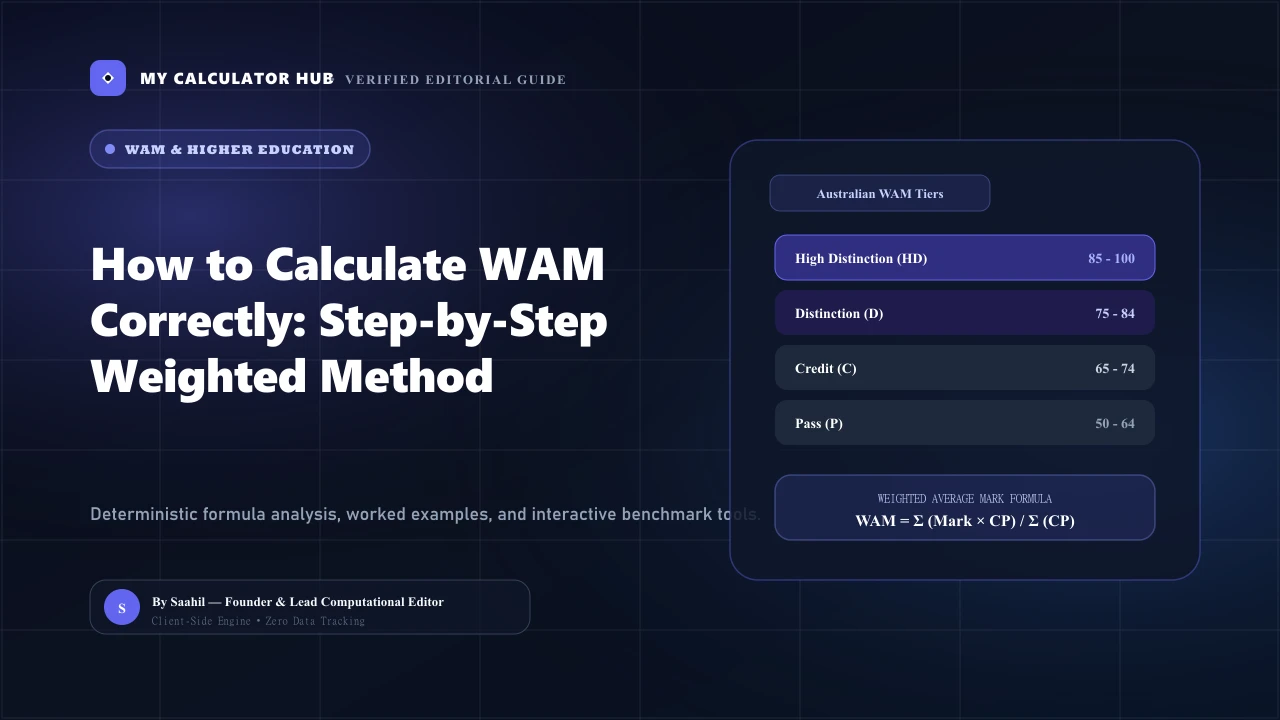
Precision begins with mathematical integrity. For weighted averages, every individual score is multiplied by its assigned credit weighting, summed, and then divided by the total sum of eligible credits. For compound returns, periodic interest rates must match compounding cycles.
General Weighted Method: Output = Σ (Value_i × Weight_i) / Σ Weight_i
Ensure denominator exclusions (e.g. non-graded passes, ungraded units) are removed prior to dividing.
Free SIP Calculator 2026 - Calculate Mutual Fund Returns
Worked Example with Planning Spread
Consider an illustrative scenario where a user combines verified historical inputs with a conservative forecast. Rather than depending on a single static outcome, the calculation is tested across three discrete cases:
Notice how constructing a 6.30-point spread provides an actionable confidence buffer before committing resources or submitting applications.
Frequent Errors in How to Calculate WAM Correctly: Step-by-Step Weighted Method
- Starting with a desired target: Selecting inputs to artificially produce a preferred number creates confirmation bias. Always input truthful parameters first.
- Unit & period mismatches: Mixing monthly figures with annual terms, or percentages with decimal fractions without proper conversion factors.
- Premature decimal truncation: Rounding numbers at each intermediate stage introduces compounding rounding distortion. Retain full precision until displaying the final output.
- Treating planning estimates as binding contracts: Online planning engines assist scenario evaluation, but never replace certified institutional records.
Source Quality Verification Standards
Verify whether the publishing institution controls the official definition and certification.
Confirm rules, indexation rates, or grading bands have not been amended in the latest policy cycle.
Ensure all mandatory units, fees, credits, and historical records are included without omission.
Preserve source documentation so an independent auditor can replicate identical results.
Related Calculators & Computational Engines
SIP Calculator
Use our free SIP Calculator to estimate your mutual fund returns. Plan your investments and track wealth creation easily.
PPF Calculator
Calculate your Public Provident Fund (PPF) maturity amount, total interest earned, and investment growth over 15+ years. Plan your tax-free retirement corpus easily.
FD & RD Calculator
Calculate your Fixed Deposit (FD) and Recurring Deposit (RD) returns accurately. Find out your total maturity value and wealth gained.
APY Calculator
Calculate your Annual Percentage Yield (APY) based on interest rate and compounding frequency.
WAM Calculator
Calculate your university Weighted Average Mark (WAM) easily. Just enter your subject marks and credit points.
Discount Calculator
Instantly calculate your final price after discounts and taxes. Find out exactly how much money you are saving during sales.
Questions & Answers
What is the most effective way to begin evaluating this topic?
Begin by articulating a single, clear question. Collect verified inputs from your primary records, compute a baseline, and run sensitive scenarios before drawing conclusions.
Why might different calculation tools show slightly different results?
Discrepancies almost always stem from differences in intermediate rounding, period compounding intervals, or distinct inclusion/exclusion rules (such as non-credit courses or fee structures).
Can I use this result for formal institutional submissions?
Planning tools are designed for personal guidance and scenario forecasting. For official applications, always submit certified transcripts or official statements provided by your controlling institution.
Editorial Transparency & Methodology
This guide is maintained by the editorial and computational engineering team at My Calculator Hub. Content is grounded in formal mathematical conventions, peer-reviewed educational literature, and verified financial guidelines. Our calculations run client-side in your browser with zero data retention for complete privacy.

Saahil
Founder, Computational Math Specialist & Lead Editor
Saahil is the founder and lead editor of My Calculator Hub. With a background in computational tool engineering and applied financial arithmetic, he develops high-precision calculation engines and educational masterclasses designed to bring mathematical clarity to students, professionals, and everyday decision-makers. Every tool and formula published under his direction is rigorously verified for unit accuracy, standard deviations, and 100% client-side privacy.